Train Your People
Train the people responsible for getting it right.
6 hours. 6 domains. One practical production standard.
The Texture Ready™ Cohort trains the people around the chair: the ones who plan, hire, budget, schedule, document, and respond. Not technique. The production competencies that decide whether a qualified stylist can actually do the job.
Join the Public Cohort as an individual, or bring the same curriculum privately to your organization.
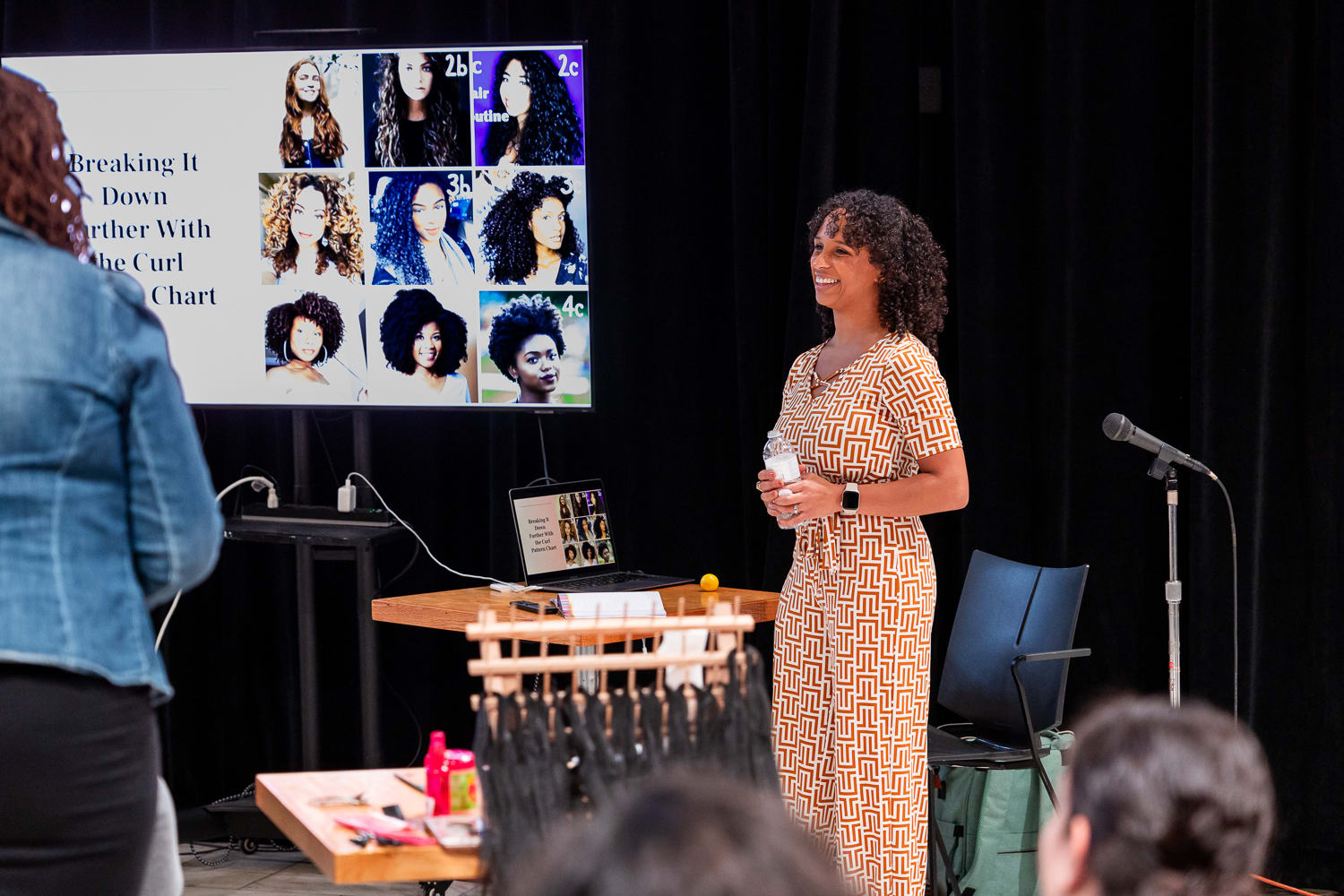
Black Hair Is Hair · Cambridge · 2023
Choose Your Cohort
Same standard.
Two ways into the room.
The curriculum, assessment, and Texture Ready™ Standard Credential are the same. Choose the format that fits how you're entering the work.
Public Cohort
Now enrollingFor individual professionals
Across production, hair, management, education, unions, and the wider industry.
$997/person
Mondays · November 30, December 7 and 14, 2026 · 1:00–3:00 PM EST
- Full 6-domain Texture Ready™ curriculum
- All 6 hours of live instruction
- Knowledge checks and applied exercises
- Credential assessment
- Texture Ready™ Standard Credential upon successful completion
- Same curriculum taught in the Private Cohort
- Limited to 25 seats
Register yourself, or have your employer, union or sponsor cover your seat.
Need a sponsored seat? A limited number may be available through industry sponsors. Request consideration.
Private Cohort
For organizations
For organizations that want their own team trained together.
$8,500
- 3 × 2-hour virtual sessions
- 2 × 3-hour virtual or in-person sessions
- 1 × 6-hour in-person day
- Existing organizational tailoring and scheduling remain
Who attends
The people who make
the work possible.
The Cohort is for the people who plan and resource the production and the people who lead and carry out its hair work. Producers, managers, designers, department heads, supervisors, and practitioners learn how their responsibilities connect across the production.
Hair professionals bring the craft. Production teams bring responsibility for budgets, staffing, schedules, and follow-through. The training gives both a shared framework for making the work possible.
Production coordination and craft expertise
A named person coordinates the production's intake, planning, scheduling, documentation, and follow-through. This responsibility is assigned within the existing team and carried out with the hair designer, department head, supervisor, and qualified practitioners.
Budgets and hair plans are developed with that expertise. The credential does not authorize a manager to replace a department head, override a designer's technical judgment, or perform hair services beyond their own qualifications.
- Producers, general managers, and production managers
- Stage managers and assistant stage managers
- Costume, wig, and hair department leadership
- Hair and wig supervisors and practitioners
- Artistic and executive directors
- Line producers and UPMs on film, TV, and commercial work
- Union field staff and member education teams
- Conservatory faculty and production staff
- Casting directors and agents who place talent into productions
The curriculum
Six domains.
What you leave able to do.
Every domain maps to decisions a production actually makes. Participants learn how to prepare those decisions, involve the right expertise, and follow through within their own roles.
Foundational hair knowledge across all types and protective styles. The cultural and historical context that grounds the work. Understanding textured hair well enough to make responsible production decisions.
Read a hair plan with enough understanding to ask informed questions. Recognize when a proposal needs specialist review and bring the relevant expertise into the conversation early.
Working command of styles, install, and maintenance. Install times, maintenance intervals, real costs, and feasibility across the production cycle. The language to communicate clearly with performers and professionals.
Discuss design feasibility, install time, and maintenance with the designer and qualified practitioners. Identify the experience the work requires and carry their technical requirements into production planning.
Hair as a department, built into the budget before casting. Pre-casting reserve, call sheet integration, dressing room standards, specialist labor forecasting, vendor pathways, contingency across rehearsal, tech, and run.
Build the hair budget with the designer and department leadership. Account for preparation, labor, maintenance, restoration, and contingency around the design estimate, with maintenance time on the call sheet. Planning figures support the conversation; they do not override the designer's quote.
Documented intake delivered to every performer, regardless of hair type. A consent framework signed before the first hair call that defines what the production is and is not authorized to do, and creates a record for both sides.
Learn what performers need early enough for it to shape the plan. Hold a record if anything later breaks. Never ask a performer to consent to something in the chair.
The relational competency. Holding a hair conversation that is not an interrogation. Recognizing that silence is not consent. Speaking honestly with directors about feasibility without making the performer the messenger.
Put performers in chairs, not in the position of educating their own production. Tell the difference between a performer who is satisfied and one who is managing your discomfort.
A defined escalation pathway known to every performer before first rehearsal. Stop-the-line protocol, design renegotiation, incident documentation, and working knowledge of the relevant union provisions in AEA, SAG-AFTRA, and IATSE agreements.
Establish who responds, who can pause the work, and how concerns are documented and resolved, with the hair department inside the decision chain. Know when to involve management or union representatives.
What the Cohort is not
Not hands-on
technique training.
The Cohort teaches the production conditions around hair work: planning, budgets, schedules, consent, communication, and escalation. It does not teach or assess hands-on hairstyling techniques.
Stylists bring the craft. The Cohort trains the six domains as production-environment competencies so the craft has somewhere to land.
For stylists and practitioners
Yes, you can enroll directly.
Hair professionals earn the same Texture Ready™ Standard Credential through the same 6-domain curriculum. The credential covers the production environment around the hair work. It does not certify hands-on styling technique.
The Fall 2026 Public Cohort is open now at $997/person.
Included with Equip
2 cohort seats. Required before the build.
Every Texture Ready™ Equip engagement includes 2 seats in a shared cohort, where participants learn alongside people from other organizations. Your designated participants complete the 6-hour curriculum and pass the credential assessment before the Equip build begins.
We confirm the participants and cohort dates during scoping. The training is included in the engagement fee. Your production's records and implementation work are handled within its own Equip engagement.
Cohort format
One curriculum.
Two delivery paths.
Public Cohort — $997/person. Three live virtual sessions, 2 hours each, on a fixed cohort schedule. The Fall 2026 cohort meets Mondays · November 30, December 7 and 14, 2026 · 1:00–3:00 PM EST. Limited to 25 seats. Register for the Public Cohort →
Private Cohort — $8,500. The same 6 hours across the 6 domains, delivered for your organization alone and tailored to your roster, agreements, and productions. Your organization chooses from the delivery options below. The shared-cohort seats included with Equip follow confirmed cohort dates.
Three virtual sessions
2 hours each, spread across days or weeks. The default for distributed teams and union staff.
Two half-days
3 hours each, virtual or in person. Fits a production week without losing a full day.
One full day
In person, retreat-style. The strongest option for leadership teams and conservatory faculty.
Share the room
No budget for a full cohort? Convene one. $8,500 covers the room, so peer organizations can fill it together: 3 organizations sending 4 people each is 12 seats, $10,000 total, about $3,333 per organization, invoiced separately. One organization convenes, everyone's people get trained and credentialed. Funders and service organizations can sponsor a shared cohort outright.
Every format includes a knowledge check after the first session, a live walkthrough of the hair budget tool, and the assignment that makes it real: you run a production of your own through it before the final session. You leave with the starter intake and consent template, the ledger of 10 production defaults, your own escalation pathway page, and the credential assessment.
Texture Ready™ Private Cohort
Train Your People
Investment
$8,500
Up to 10 participants. $750 per additional seat, 16 maximum.
Need your wider team trained together? The Full Standard pairs a private cohort with the Equip build, from $19,500. Equip already includes 2 shared-cohort seats; the private cohort provides tailored delivery for the broader team.
Bring a Cohort to Your Organization →The credential
A standard your people
carry forward.
Participants who complete the curriculum and pass the assessment become Texture Ready™ Credential Holders. The assessment runs 12 questions across the six domains. 9 are knowledge-based and can be reviewed in advance. 3 assess relational competency, are administered live, and are not published.
The credential is valid for 2 years with a renewal pathway in the third. It travels with the individual: to the next production, the next company, the next contract.
- Issued to individuals who complete the full curriculum and pass the assessment
- Verifies demonstrated knowledge across Literacy, Fluency, Architecture, Consent, Care, and Escalation
- Does not certify hands-on styling proficiency, and is not meant to
- Training alone does not make a production Equipped. The organizational mark requires a completed Equip build and 2 active Texture Ready™ Credential Holders assigned to the work, together with the applicable organizational requirements. Every Equip engagement includes 2 cohort seats to support that requirement
- Verifies production knowledge. It does not certify hands-on styling proficiency or replace the qualifications and experience required for a particular role
Two cohorts in
The room
keeps agreeing.
Convened in Cohort 1
From Feedback Respondents
Theater · Film · Casting · Education · Legal · Union · Press · Tech
"This is not just an added, nice-to-have thing for productions, but actually critically necessary, and easier and more practical to implement than I would have thought."
"The level of intention required is important, but it is not hard if people do just a little of the work they would do for anything else critical to a production."
"There is so much I need to understand, and Kira's presentation was an honest, knowledgeable, and passionate way for me to learn about this important topic that affects so many actors in our community."
Beyond a single production
Adapted for unions,
industry bodies, and
conservatories.
The same 6 domains are adapted for the people who support production practice across a membership or institution. Union field staff and member education teams learn to recognize gaps, ask informed questions, and support appropriate escalation. Conservatory faculty and production staff learn to apply the standard within their own programs and productions.
Unions and industry organizations → The Conservatory Standard →
Ready to train?
Join the Fall 2026 Public Cohort
$997/person
- 3 live virtual sessions
- 6 hours
- 6 domains
- Mondays · November 30, December 7 and 14, 2026 · 1:00–3:00 PM EST
- Limited to 25 seats
Training a whole team? Private Cohorts begin at $8,500 for up to 10 participants.
Bring a Private Cohort to Your Organization →Need to make the case internally first? The one-page overview is here.