For Performers
Your contract sets the bare minimum. Most productions improvise the rest.
Before you sign, know exactly what your Equity or SAG-AFTRA contract already requires a production to do for your hair. Then know what it leaves undefined, and what to ask.
Start here
When a production has no hair system, the labor does not disappear. It lands on you. You come in early to maintain your style. You buy your own products. You manage your own care on top of eight shows a week. You stay quiet, because no one ever named whose job it was.
Here is what most performers are never told: parts of that labor are already the production's responsibility. Your contract says so, in writing, right now. The catch is that a contract sets a bare minimum, and a bare minimum only protects you if someone actually runs it.
Texture Ready™ is the difference between a production that improvises around your hair and one that was ready before you walked in.
What you're already owed
The bare minimum, in writing
Two kinds of contract govern most professional work. Here is what each one already requires. Not best practice. Not someday. Now.
Theater
Actors' Equity / LORT & NEATThe production owns the hair worn onstage. Wigs, hairpieces, and facial hair are provided clean, and kept that way by the producer. Responsibility for all performance hair sits with them, not you.Clothes & Make-Up, 13(I)
Any style that can alter or risk harm (relaxers, chemical services, weaves, braids) requires a licensed, qualified technician you both agree on, with upkeep and maintenance planned together.Clothes & Make-Up, 13(I)(3)
No one can require you to cut, shave, or restyle your hair without your written consent, flagged at the audition, with the production covering the cost and upkeep.Clothes & Make-Up, 13(K)
No forced color change without written consent. If you agree, they pay to make the change, maintain it through the run, and professionally restore your color at the end.Clothes & Make-Up, 13(J)
Tights and skin parts must match your skin tone, and gender-affirming choices are respected.Clothes & Make-Up, 13(F)
Discrimination based on hair texture is named as race discrimination, and prohibited.Anti-Discrimination, Rule 24
Film & TV
SAG-AFTRAYou must be offered a meaningful consultation about your hair and makeup needs before work begins, so the department is prepared with the right products and equipment for your hair.Hair & Make-Up, Item 16
If the production cannot provide qualified hair or makeup personnel, it must reimburse your pre-approved outside services and pay you at least two hours at your rate (or the actual time, whichever is greater).Hair & Make-Up, Item 16
A standing commitment to grow the pool of stylists skilled across all hair textures and skin tones, including natural texture, braiding, twists, locs, and fades.Hair & Make-Up sideletter
These terms carry forward into the new contract in effect July 1, 2026 through June 2030. They are current, and they are staying.2026 TV/Theatrical Agreement
Exact wording and section numbers vary by agreement. Theater language above is quoted from the New England Area Theatres (NEAT) agreement in effect now; LORT and other Equity contracts carry parallel hair and anti-discrimination language. SAG-AFTRA language is quoted from the ratified TV/Theatrical agreement.
The gap
"Qualified" is in your contract. A definition is not.
The bare minimum is real. It is also full of holes. Three of them matter most.
The word "qualified" is everywhere, and defined nowhere.
Both Equity and SAG-AFTRA require qualified hair personnel, then leave the word open. SAG-AFTRA's own language only commits the parties to one day discuss criteria for what qualified means. Until someone defines it, every production gets to decide for itself.
The burden to invoke it is still yours.
Reimbursement means you found the stylist, booked the chair, and fronted the labor. The clause pays you back. It does not prepare the production, and it does not give you the time back.
It triggers after something goes wrong, not before.
A consult is a conversation. A reimbursement is a refund. Neither is a system. The protections activate once you are already in the chair with a problem, which is the worst possible moment to be negotiating.
Improvising
Waits for you to invoke a clause.
No named lead. No real budget. The plan is the contract, and the contract only moves when you push it. The labor finds you.
Texture Ready™
Already runs the system.
A qualified Hair Lead with authority. A budget built for every hair type before casting. Documented protocols. You never have to invoke anything, because it was handled before you arrived.
What's next
The bare minimum is about to be renegotiated.
The protections you have now are not the last word. The timing matters, and right now it favors theater.
Before you sign
Five questions. Ask them out loud.
Your contract gives you the standing to ask. Use it.
Who is your Hair Lead, and what authority do they hold?
Not "who does hair." Who is responsible for planning and protecting hair across the whole cast? Do they have a budget and scheduling input? If the answer is a costume designer or an ASM, ask: have they been trained on all hair types, including protective styles and Type 4 hair?
Was the hair budget built before or after casting?
A production that planned for hair before they knew who they were casting built a system. One figuring it out now built a workaround. That workaround lands on you.
If my style needs a chemical service, a weave, or braids, who is the licensed technician?
Your Equity contract already requires a licensed, qualified technician you both agree on for these services. If they have not thought about who that is, they are not ready, and you have the standing to say so.
What products are stocked in the room for my hair type?
Not "we have hairspray and bobby pins." Specifically: curl definers, edge control, braid spray, moisturizing creams, loc spray. If the answer is "we can get whatever you need," that means they have not thought about it yet, and you will be managing it.
If something goes wrong with my hair mid-run, what is the process?
There should be a named person, a documented escalation path, and a stop-the-line protocol. If the answer is "just let us know," there is no process. The burden lands on you, mid-run, while you are also performing.
Proof
This already works.
When a production runs hair as a system, the difference shows up onstage and at the box office. On one regional Hairspray, a Texture Ready™ approach (a qualified Hair Lead, a real budget, documented protocols) supported a fully textured cast from first rehearsal through closing.
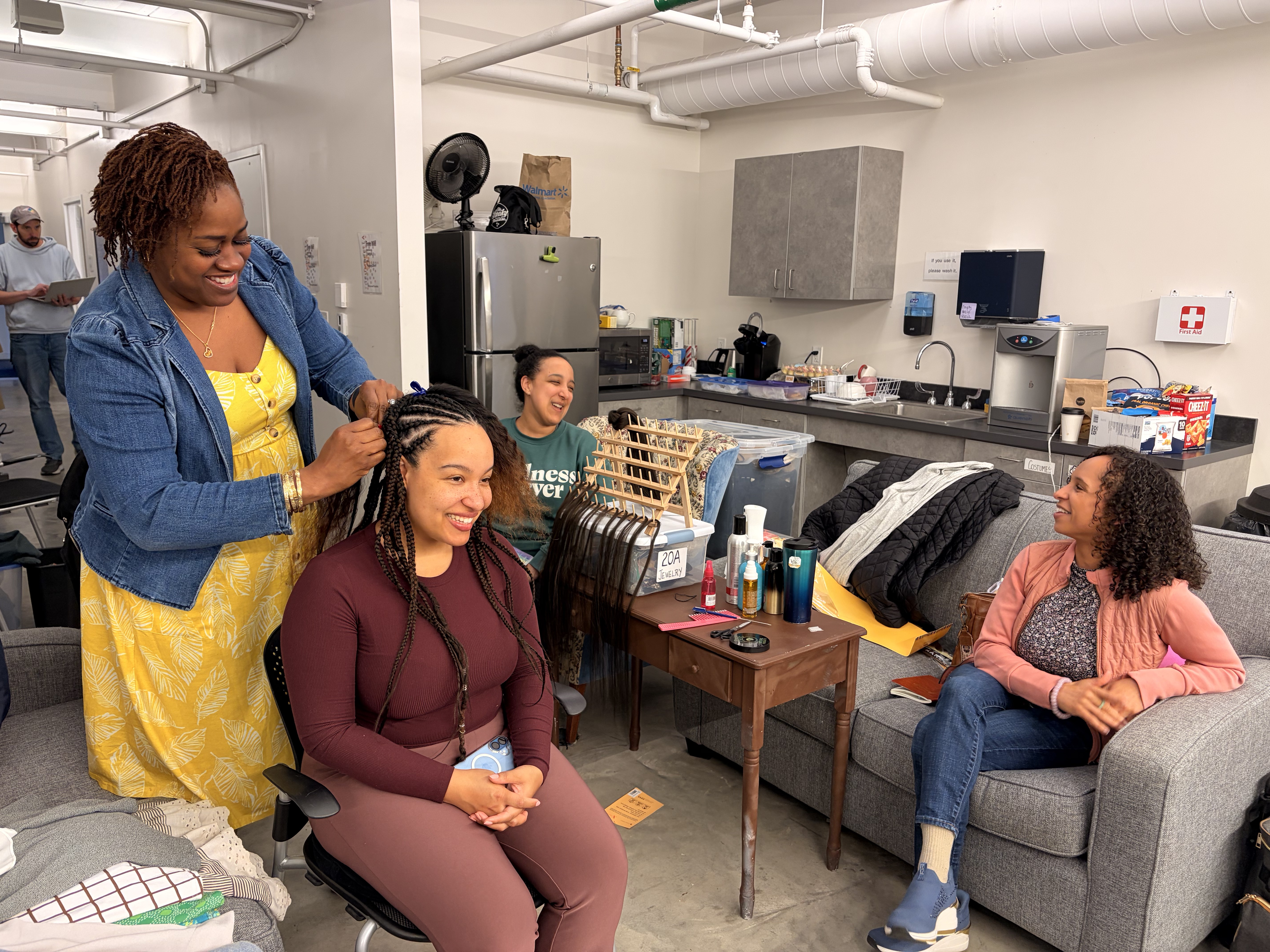
The reverse is just as instructive. When the bare minimum fails and no one documents it, the cost lands on the performer. That failure is playing out publicly in the Boston courts right now, and it is the reason a production-side standard exists at all.
Take it with you
Five questions. Yours to keep.
Print the card for your audition bag. Send this page to a castmate. No email, no sign-up, no catch. It is free because it should be.
Is your production not ready yet? There is a path. It starts with a conversation. See the standard →
Stay informed